
Originally written in April 2018 | Harrisonburg, Virginia
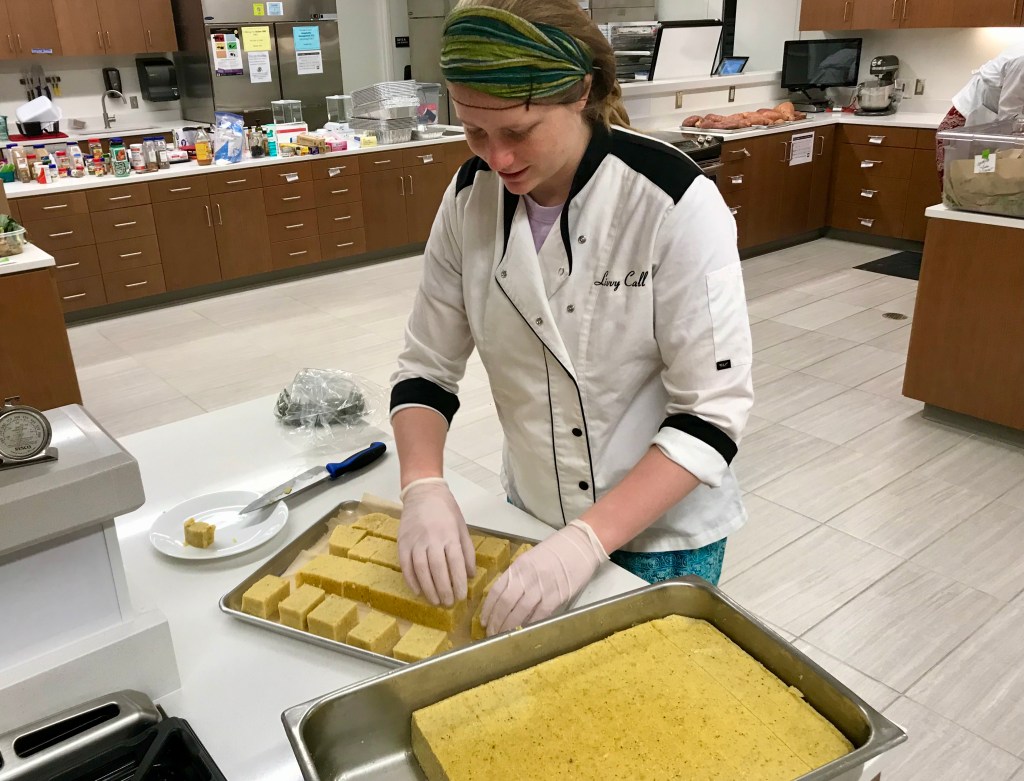
Midmorning on an early spring Friday, four students in personalized chefs’ coats buzzed Four students in personalized chefs’ coats buzzed around the dietetics kitchen on the campus of James Madison University (JMU). Scents of baking rosemary meatballs and sautéing garlic-sage sweet potatoes promised a delicious spread for the evening. More than 100 people had accepted the invitation to the event “Cultivating Community,” which would start in less than eight hours.
Senior dietetics student Livvy Call had planned for several months after winning the JMU Student Mini-Engagement Grant to fund the event. Over 100 people –including fellow students, professors, community leaders, residents, and farmers— accepted the invitation to the 6 pm meal. The event aimed to connect the ingredient-growers to the eaters, a connection that continued to fracture after the industrialization of the United States’ food system.
She bounced between the stations where several event volunteers, her friends, cooked and stirred. For years, she imagined different people mingling over a free and locally sourced meal. It was a rebellion against the impersonal and commodified food system.
Recognizing the disconnections
“If I can make [local food] available to everybody, make it inclusive, that’s what I really want to be able to do,” Livvy said.
The Virginia Cooperative Extension conducted a Food Equity Assessment for Harrisonburg in 2017. Low-income households, which describes 32% of households in Harrisonburg, had less access to fresh produce and locally grown food than higher-income households. In the assessment, researchers called on grocery stores to offer more locally grown and culturally diverse foods. Doing so would require producers, retailers, and eaters to learn and help educate the community about different products.
Livvy enjoyed teaching through sharing food. She chose both popular and typically unfamiliar ingredients for the meal, ranging from blackberries to Jerusalem Artichokes.
While the event focused on relational connections, it also promoted appreciation and personal reflection. In the 2018 Michigan Food Literacy Poll, 50% of people surveyed rarely or never ask where their food was grown or how it was produced. Livvy believed that sharing a meal could raise questions about the food system in an inviting, positive way.
While peeling salsify at the back counter, Livvy delegated directions to the set-up crew a mile away through texts. Her cell phone continued to play a folk indie band playlist, and the student chefs bopped around to the tunes as they sliced and stirred at their stations.
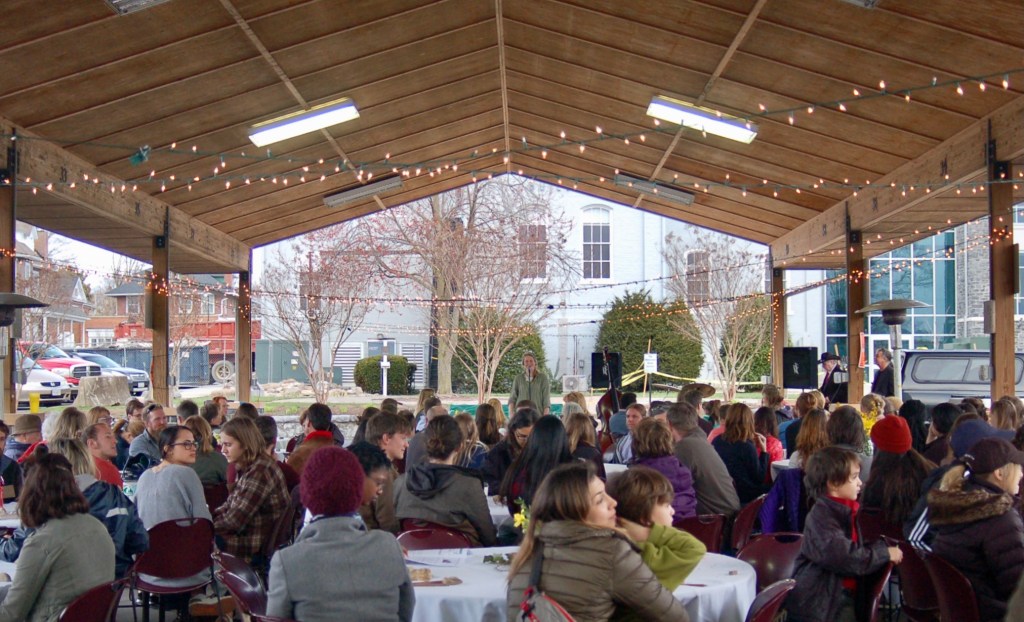
Livvy chose the Turner Pavilion as the location because of its familiarity and accessibility to different groups in Harrisonburg. During the growing season, vendors set up the Farmers Market under the pavilion. Many of the vendors provided produce the food for the event.
Building linkages
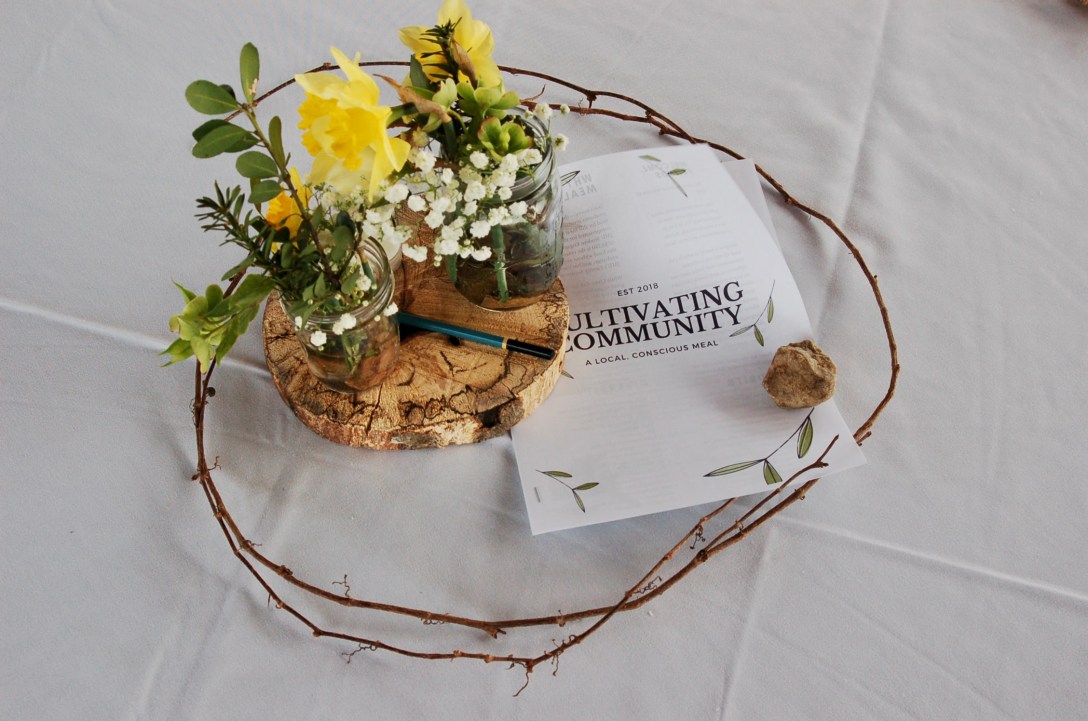
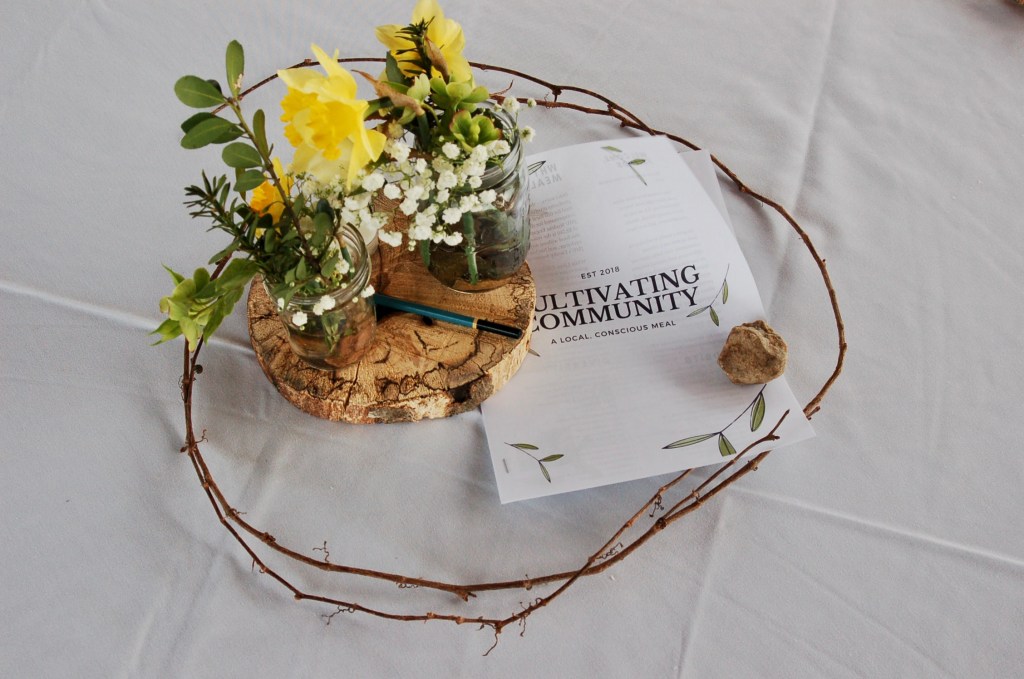
Meanwhile, the set-up team fought blustering winds as they prepared the pavilion. One volunteer placed a schedule for the evening on each table. Livvy and her sister had written the schedules on the back of a paper grocery bag in clear calligraphy to minimize waste.
Reducing waste proved an essential element of the evening. From using compostable tableware to borrowing creative décor from friends, Livvy provided an example of a low-waste event.
In 2017, the U.S. threw almost 40% of our food in landfills according to a study by the Natural Resources Defense Council. The widespread lack of education, poor consumer habits, and lack of infrastructure play a role in these numbers. The company Black Bear Composting set up a scrap collection in 2016 in Harrisonburg to help educate and increase participation in citywide composting. Their collection bin area sits close to the Turner Pavilion for easy access.
Student volunteers raced around the tables to set rocks on the cloths. The string lights whipped side-to-side, table décor toppled over, and a glass vase crashed to the ground.
At 5 pm, one hour before the event, Livvy’s parents drove up. They opened their hatchback to pull out the centerpieces of yellow flower bouquets. They reassured the volunteers they’d bring the porter john soon, and they’d pick up whatever else was needed.
Soon after, the jazz trio Eva Weber arrived. They had driven from Luray, Virginia—about 45 minutes away—to support Livvy’s vision of a localized food event. On the other side of the pavilion, three local businesses set up stands to showcase their work, including a mushroom farmer and a tree farmer.
One of the key players in the event was Dustyn Vallies, the co-founder of Food From Friends, an app to connect farmers and home gardeners to consumers, chefs, and wholesale buyers in their communities. Livvy met Dustyn at a food sustainability conference in 2016. They saw the meal event as a mutually beneficial test run for the app and its potential to localize food sharing. With contributions from half a dozen farmers and over 200 people interested in attending, the trial was setting up to be a success.
The event had started, but Livvy and her food had yet to arrive.
Digging deeper
While moving ingredients from the stove to the oven, Livvy wondered aloud about whether her car would get towed. It was supposedly safe in the loading zone, but one was never sure on campus.
“Oh well,” Livvy told her volunteers with a shrug and a smile. “Let it go and make room for love.” The phrase came from her mother, who encouraged Livvy’s love for nature and community. Spending childhood in a close-knit family and exploring the outdoors, she described how “fortunate” and “privileged” she was to do such “cool, exploratory things.”
Livvy traced her curiosity about environmental connections back to childhood. She attended a Waldorf school through fourth grade, which emphasized practical skills and personal responsibility for one’s education. During that time, her class visited a biodynamic farm in New York called Hawthorne Valley Farm, and she cherished the experience. In her college years, she and her sister Lucy, a fellow dietetic student at JMU, even returned to the farm to attend a cooking class.
Livvy’s academic achievements allowed her to take a semester off in college to explore alternative food systems. In 2015, Livvy cooked at Ballymaloe Cookery School in Ireland. Seeing how the farmers brought together nature and cooking fanned her passion for sustainable food. The chefs cooked “pop-up meals,” to bring food to people who usually wouldn’t have access to such fine and local cuisine. All the while, Livvy wondered, Could this happen in Harrisonburg?
“I can eat locally. I can afford that, and I want to be able to support that,” she said. “But seeing more about the social issue, I need to go deeper.”
Racial and socioeconomic disparities are prevalent in the food system. People dealing with food insecurity might not prioritize connecting with local producers and ingredients. Even further, “eat local” campaigns that emphasize expensive produce and shame individual choices fail to recognize systematic food injustice.
Livvy recognized this in her food activism, as a JMU chapter co-leader of the food rescue organization Campus Kitchen and working with ecological justice groups around the area. She sees events like Cultivating Community as an educational opportunity that can lead to action. For some, she knew the action might be to simply feel deeper gratitude for producers.
Scattering seeds of appreciation
Twenty minutes after the event’s starting time, the jazz trio played as the growing crowd mingled. Livvy arrived in a JMU Dining Services truck, and several volunteers rushed to help unload supplies.
“Thank you so much for helping us out,” Livvy said to the driver. “We really, really appreciate it.”
The guests looked over curiously. Volunteers filled the trays with pounds of arugula, vegan whole-wheat rolls, pickled deviled eggs, pulled pork, local fruit, and roasted Jerusalem Artichokes—the uncommon ingredients always drawing a smile from Livvy.
As the team set up the meal, speakers entertained the guests. Farmers talked about their Community Support Agriculture (CSA) programs. JMU senior Zak Gordon performed a spoken poem about Romanesco. Once the buffet tables were prepared, the speakers invited the guests to line up.
Most of the conversations in the buffet-style lines tried to figure out the ingredients.
“What is that?”
“Um, it looks like potatoes.”
“It says ‘Bok Choy.’”
“Then that’s what it is.”
“I’ll try it.”
By 7:30 pm everyone had finished their first serving, most of them tasting at least one unfamiliar food. The wind calmed down, the night cooled off, and the space heaters warmed the guests. The attendees listened to ten local farmers describe their process and visions for change.
“We’re in a state that puts growers and eaters against each other,” said Jonathan McRay, a farmer of Blacks Run Forest Farm, who stood barefoot as he spoke. His critical questions challenged the guests to recognize the brokenness food system, yet he also offered hope to reconstruct it as an interconnected network.
The plates and trays emptied for a second time. Livvy thanked the guests, and they wildly applauded the event with whistles and cheers. Professor Adrienne Griggs, who had helped Livvy turn in the grant application the night of the deadline, handed her a bouquet.
The next morning, Livvy and a friend ate breakfast at The Little Grill Collective, a worker-owned restaurant with a menu that embodied Cultivating Community’s vision.
“Hey!” a person stopped to look at her. “You’re the one who did the meal, that was awesome.”
She didn’t know them but thanked them for their support. Later that afternoon, another stranger complimented the event when she went to a coffee shop later in the afternoon.
“I felt overwhelmed with it,” she said. She appreciated the recognition but wanted some time to herself. She escaped to a nearby lake just outside of town, admiring how the environment and community nourished each other.
 sarahkoth.com